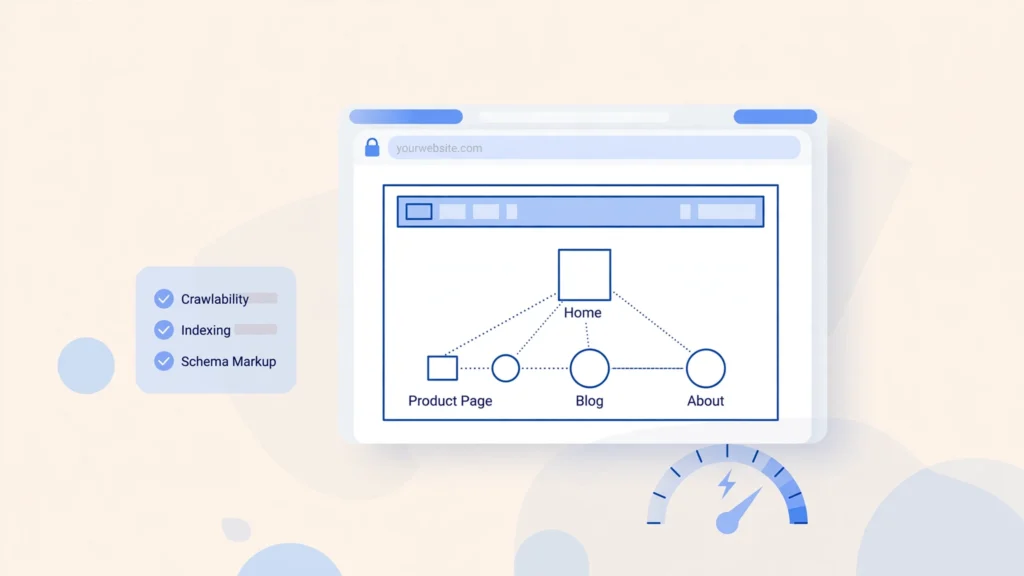
If you’ve ever sat through an SEO pitch where the speaker said “we’ll do technical SEO” and you nodded along without really knowing what that meant, this guide is for you. Technical SEO is the behind-the-scenes work that lets Google find, understand, and rank your website — and it matters more than most content-heavy campaigns admit. Here’s what technical SEO services actually include, how they’re delivered, what they cost, and how to tell a good provider from one that just sells you a 40-page PDF.
What “Technical SEO” Actually Means for a Business Owner
Strip away the jargon and technical SEO comes down to three baseline requirements Google itself describes:
- Googlebot must be able to access the page. Nothing blocks it — not a misconfigured robots.txt, not a server that times out, not a login wall someone accidentally put on the live site.
- The page must work and return an appropriate response. No broken pages, no redirect chains, no server errors on pages that matter.
- The page must contain indexable content. Google has to be able to read the content — not just a blank JavaScript shell it can’t render.
Meeting these requirements doesn’t guarantee rankings. But failing them can prevent visibility entirely. A site with blocked pages, broken rendering, or crawl traps is like a shop with the lights off and the door jammed — the best products inside don’t matter because nobody can get in. If your rankings are flat despite publishing good content, technical problems are one of the first places to look. A professional SEO audit is usually the starting point for finding them; technical SEO services are how they get fixed — and stay fixed.
What’s Typically Included in a Technical SEO Service
Technical SEO isn’t one task; it’s a set of systems that all have to work together. Here’s what a competent service actually covers, in plain language:
Crawl and indexation
Can Google find every important page, and is it wasting time on junk pages? The provider crawls your site the way Google does, checks your XML sitemap and robots.txt, finds pages that are blocked, orphaned (no internal links pointing to them), or stuck in crawl traps, and fixes how your crawl budget is spent. On a 20-page business site this is quick; on a 10,000-product store it can be a project.
Rendering and JavaScript
Many modern sites — especially ones built with JavaScript frameworks — send Google a blank or partial page that only “fills in” when a browser runs the code. Google can render JavaScript, but it doesn’t always do it well or quickly. A technical SEO specialist checks what Google actually sees (rendered output, not your browser’s view), and fixes rendering problems that leave pages looking empty to the crawler.
Site architecture and internal linking
How your pages connect to each other. Important pages should be reachable in a few clicks from the homepage, with descriptive internal links — not buried five levels deep or only linked from the sitemap. Bad architecture doesn’t just confuse visitors; it dilutes how Google values your pages.
Speed and Core Web Vitals
How fast your pages load on real phones matters for rankings and for conversions. This overlaps with website speed optimization: image compression, caching, server response times, and the specific metrics Google measures (Largest Contentful Paint, Interaction to Next Paint, Cumulative Layout Shift). Technical SEO identifies which speed problems actually affect rankings versus ones that are cosmetic.
Structured data and schema
The machine-readable markup that tells Google “this is a product with this price,” “this is a local business at this address,” or “this is a recipe.” Properly implemented schema can earn rich results in search (star ratings, FAQs, product info); broken schema gets ignored or, in bad cases, flagged.
Redirects, canonicals, and duplicates
Redirect chains, wrong canonical tags, and duplicate URLs are among the most common technical problems — and one of the most common causes of ranking drops after a website redesign. A technical SEO service maps every URL change, sets up proper 301 redirects, and makes sure canonical tags point search engines at the right version of each page.
Ongoing monitoring and validation
This is what separates a real service from a one-time report: after fixes ship, someone verifies they actually worked — re-crawls the site, checks Search Console coverage, and confirms the errors are gone instead of assuming. As one specialist agency puts it, the deliverable is “a findings document, a prioritised ticket backlog, verification after each fix ships, and a crawl diff after every significant release.”
One-Off Project vs Ongoing Technical SEO
Not every site needs a monthly technical retainer. The right model depends on the site:
A one-off engagement suits a small, stable business site that doesn’t change much. The provider audits the site, fixes the issues, validates the fixes — done. Revisit once or twice a year, or when something changes (a redesign, a platform migration, a big content expansion).
Ongoing technical SEO makes sense when the site changes constantly: ecommerce stores with new products, sites that deploy code weekly, businesses running multiple languages or markets. Every release can introduce new technical debt — a template change that breaks canonicals, a plugin update that slows the site, a staging subdomain that gets indexed. Ongoing means someone watches coverage between releases and keeps a standing backlog so small problems don’t accumulate into ranking drops.
Be wary of anyone who pushes a monthly retainer on a 15-page brochure site that hasn’t changed in two years. And be equally wary of anyone who treats a 50,000-URL store as a one-and-done job.
Do They Fix the Issues or Just Hand You a Report?
This is one of the most important questions to ask, because “technical SEO services” means different things to different providers:
- Report only. They deliver findings and recommendations; your developer (or your nephew) implements them. Cheaper, but the fixes often never happen — or happen wrong.
- Implement on your platform. For WordPress or Shopify sites, many specialists can implement fixes directly — staging first, with your sign-off.
- Write tickets for your developers. On custom platforms or larger sites, the SEO specialist writes implementation tickets with acceptance criteria, and your team ships them.
The model should be priced accordingly and stated up front. If a proposal doesn’t say who implements the fixes, assume it means report-only — and ask what “implementation support” costs before you sign.
How Much Do Technical SEO Services Cost?
Industry pricing generally follows two models (figures below are third-party market ranges for context, not Codeify Digital’s pricing):
- Fixed-scope audit or one-off project. A defined engagement — audit, fixes, validation — quoted as one price before it starts. Some agencies offer free automated scans as a scoping step; treat those as sales tools, not diagnoses.
- Monthly retainer for ongoing work. The price moves with the number of URLs, templates, markets, and languages involved, and whether the provider implements fixes or hands a backlog to your developers.
What should raise your eyebrow: a single flat price for every site (“technical SEO, $299/month, any website”), or pricing that doesn’t ask about your site’s size and platform before quoting. A legitimate provider scopes before they price. For the full picture on SEO budgeting, see how much SEO costs per month.
Signs Your Site Needs Technical SEO Work
You don’t need a degree to spot the warning signs. Consider a technical review if:
- Your rankings or traffic are flat — or falling — despite publishing good content.
- Google Search Console shows pages as “discovered but not indexed” or “crawled but not indexed” with no obvious reason.
- You redesigned or migrated the site and rankings dropped.
- Your site is painfully slow on mobile, or pages shift around while loading.
- You have an ecommerce store, a multilingual site, or a JavaScript-heavy site — all magnets for technical problems.
- You’ve never had anyone look at the technical side, period. Most small business sites haven’t.
How to Choose a Technical SEO Provider
Green flags: they ask about your site’s platform, size, and release process before quoting; they show you what Google actually sees (rendered output, Search Console data), not just a tool’s warning count; they prioritize findings by impact on important pages instead of handing you 400 warnings; they validate fixes after implementation; they can explain any finding in plain language; they tell you honestly when you don’t need them.
Red flags: a proposal that’s identical for every client; hundreds of “critical errors” from an automated scan with no prioritization; guaranteed rankings or guaranteed traffic increases; refusal to explain what they’re doing (“it’s technical, you wouldn’t understand”); monthly retainers pushed on sites that don’t change; upselling link building before the technical foundation is sound. A house with a cracked foundation doesn’t need new curtains.
If you’re also evaluating general SEO providers, our guide on how to choose an SEO company covers the broader vetting process.
Where Technical SEO Fits With the Rest of Your SEO
Think of SEO in three layers: technical SEO makes the site crawlable and fast; on-page SEO and content give Google something worth ranking; authority (links, reputation) moves the needle over time. How long SEO takes depends heavily on which layer is broken — a technical fix can unlock rankings that were stuck for months, while content and authority compound slowly.
You can’t skip the foundation. If your site has technical problems, every dollar spent on content and links is working at a discount.
If your rankings have stalled, your pages aren’t getting indexed, or you just want someone competent to look at the technical side before you spend more on marketing — start with a professional SEO audit to find the problems, then fix them properly. Codeify Digital offers technical SEO services for WordPress and business websites: crawl and indexation fixes, speed optimization, structured data, and post-fix validation — scoped to your actual site, not a template. Get a free initial review and we’ll tell you honestly whether your site needs technical work or not.