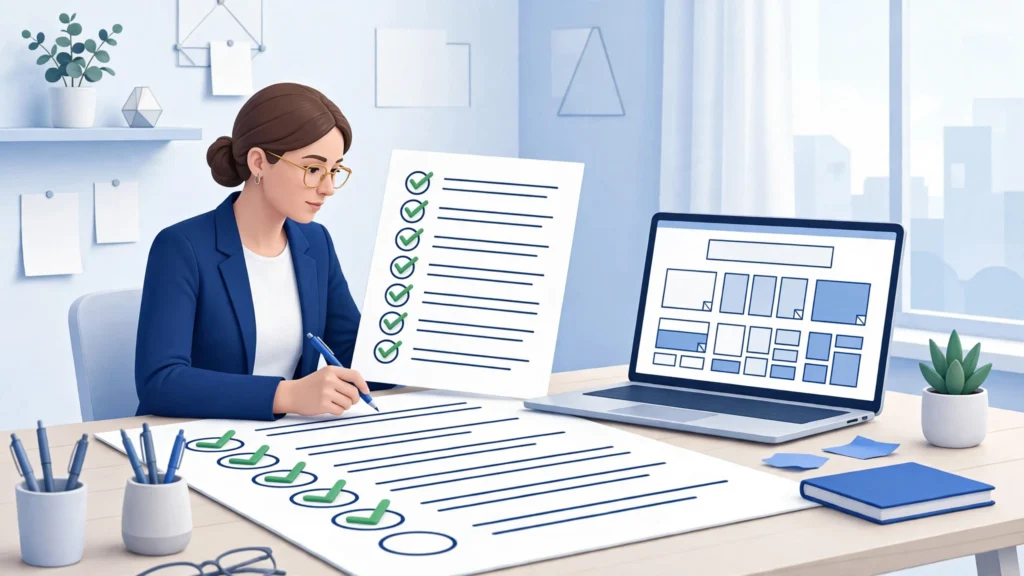
Choosing a web design agency is one of the highest-stakes decisions a business owner makes. A great agency becomes a growth partner; the wrong one delivers a pretty website that loads slowly, ranks nowhere, and needs rebuilding in eighteen months — after you have already paid in full.
The difference usually comes down to the questions you ask before signing. This guide gives you twelve of them, explains what good and bad answers sound like, and flags the red flags that should send you walking.
Before You Contact Anyone: Define Your Brief
Most bad agency choices happen before the first call, because the brief was never written down. Be able to answer three things first:
- What must the website achieve? (“Generate quote requests from local service businesses” beats “we need a new website.”)
- What is the rough budget? Even a range helps agencies propose something realistic.
- When do you need it live? A deadline shapes what is feasible.
Agencies quote wildly differently against a vague brief — which is exactly how projects go wrong. Our process page shows what a structured engagement looks like from the client side.
12 Questions to Ask Every Web Design Agency
1. Who will actually do the work?
Some agencies sell the project and outsource it to freelancers you will never meet. Ask who designs, who codes, and who your day-to-day contact is. Good answer: named people, in-house, with a single point of contact. Red flag: vague talk about “our team” with no names and no direct access.
2. Can I see live websites you built — not just screenshots?
A portfolio of screenshots proves nothing about speed, mobile usability, or code quality. Visit the live sites. Check them on your phone. Is navigation clear? Do pages load fast? Browse our portfolio the same way — every project links to real work, and we encourage you to click through.
3. What is included in the price — and what is not?
Get the scope in writing: number of pages, design revisions, copywriting (do they write it or do you?), images, integrations, and testing. Red flag: a single lump sum with no breakdown. The cheapest quote often excludes planning, SEO basics, or mobile testing — the expensive parts to fix later.
4. How many revision rounds are included?
Design is iterative, but unlimited revisions is a fantasy that ends in frustration on both sides. A professional agency includes a defined number of revision rounds per stage. Ask what happens if you need more — the answer should be a clear rate, not awkwardness.
5. What is the realistic timeline, and what are the milestones?
Ask for milestones: discovery, design sign-off, development, testing, launch. Then ask what they need from you at each stage — most delays come from the client side (late content, slow feedback), and an honest agency will tell you that upfront.
6. How do you handle SEO during the build?
SEO should be baked in, not bolted on: proper heading structure, fast load times, mobile-first design, metadata, sitemaps, and redirects if you are migrating an old site. Red flag: “we can add SEO later” or guaranteed rankings — nobody can guarantee rankings, and retrofitting SEO costs far more than building it in. See what proper SEO-ready web design includes.
7. Will the site be fast? How do you measure it?
Ask which metrics they target — Core Web Vitals at minimum — and whether they test on real mobile connections. A beautiful site that takes six seconds to load is a liability. Performance work should be part of the build, not an upsell.
8. Who owns the website, domain, and files when we are done?
Non-negotiable: you own your domain name, your hosting account, and full admin access to the website. Never sign an agreement where the agency retains ownership or holds your site hostage for ongoing fees. Ask how you would move the site elsewhere if you part ways — the answer should be straightforward.
9. What CMS will you use, and will my team be able to edit content?
If your team will publish updates, the editing experience matters enormously. Ask for a demo of the admin side. WordPress with a clean, custom setup is the most common answer for good reason — but whatever the CMS, your non-technical staff should be able to update text and images without calling a developer.
10. What happens after launch?
Websites need updates, backups, security monitoring, and occasional fixes. Ask what maintenance includes, what response times look like, and what it costs. Vague post-launch support is one of the most common regrets business owners report. Compare with a proper website maintenance plan so you know what “covered” should mean.
11. How do you measure success?
Ask: “What does a successful project look like to you?” A vendor says “a nice website, delivered on time.” A partner talks about leads, sales, or whatever your conversion goal is — and sets up analytics to track it. If the agency never mentions your business goals, they are decorating, not strategizing.
12. Can I speak to a past client?
References reveal what portfolios cannot: communication quality, honesty about timelines, and how the agency handles problems. One short call with a previous client is worth more than ten testimonial quotes. Read our client reviews — then ask us for a reference call. We will say yes.
Red Flags That Should Make You Walk Away
- Guaranteed rankings or traffic. No honest agency promises this.
- No contract, or a contract you cannot understand. Scope, price, timeline, and ownership belong in writing.
- They will not show you live work or the portfolio is all mockups.
- Pressure to sign today for a “limited discount.”
- You cannot reach a real person — everything goes through a ticket queue before you have even paid.
- The quote is dramatically cheaper than everyone else’s. It is missing something you will pay for later.
How to Compare Proposals Fairly
Line the proposals up side by side and compare the same things: scope of pages and features, design process and revision rounds, CMS and editing experience, SEO and performance inclusions, testing (devices, browsers), training, support terms, and total cost of the first year — not just the build price. The best value is rarely the lowest number; it is the clearest proposal from the team that asked the smartest questions about your business.
Frequently Asked Questions
How much does a web design agency cost?
It depends on scope, design depth, functionality, and content needs — a simple brochure site costs far less than a custom ecommerce build. Get itemized proposals and compare the full first-year cost including support, not just the headline build price.
Should I choose a local agency or can I hire remotely?
Remote collaboration works well for most projects if communication is strong — clear milestones, regular demos, and a single point of contact matter far more than sharing a postcode. What matters is responsiveness and process, not proximity.
How long does an agency take to build a website?
A typical small-business website takes four to eight weeks from kickoff to launch, depending on scope and how quickly you provide content and feedback. Be wary of anyone promising days (corners are being cut) without a clear explanation of how.
The Bottom Line
The right agency is not the cheapest or the flashiest — it is the one that asks about your business before showing you designs, answers all twelve questions plainly and in writing, and treats launch day as the start of the relationship rather than the end. If you are evaluating agencies right now, request a free quote and put these questions to us. We will answer every one of them.