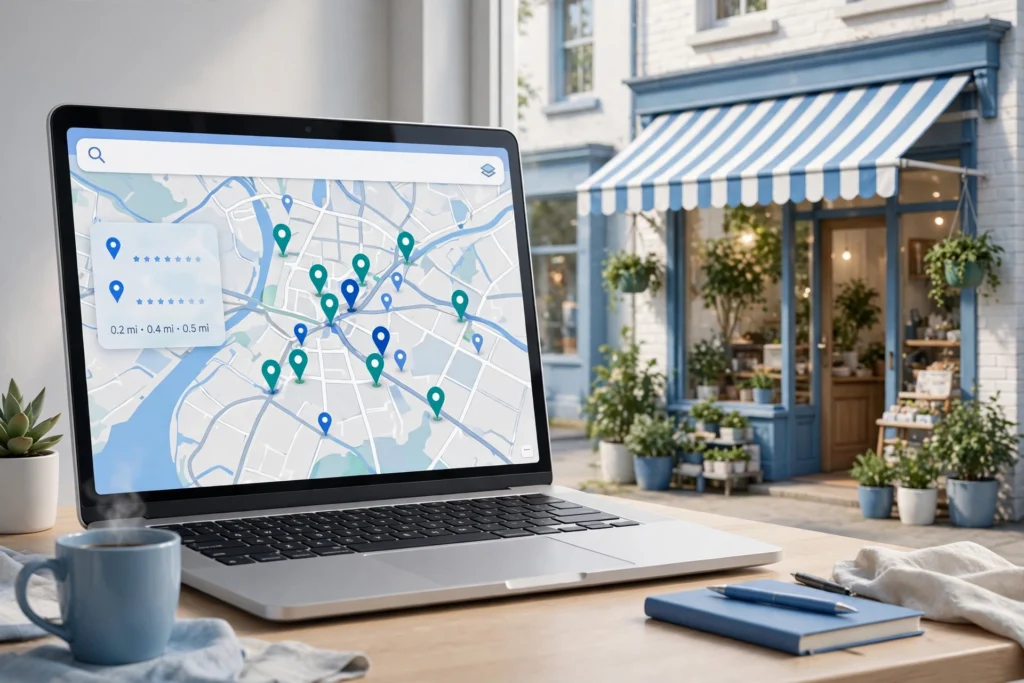
If you own a small business with a real service area — a shop, a clinic, a plumbing outfit, a restaurant — your most valuable search traffic isn’t global. It’s the person three miles away typing “plumber near me” or “best dentist in [your town]” at 9 PM. That’s what local SEO is for: getting your business to show up when nearby customers are ready to buy. This guide covers the whole picture — how Google’s local results actually work, the exact steps in the order that matters, realistic timelines, and when doing it yourself stops making sense.
What Local SEO Actually Is (and What It Isn’t)
Local SEO is everything you do to make Google confident that your business is real, relevant, and trusted for searches with local intent — “near me” searches, “[service] + [city]” searches, and the map pack that appears above regular results. It is not a separate version of SEO with secret tricks. It’s regular SEO plus location signals: your Google Business Profile, consistent business listings, local reviews, location pages, and local content.
What it isn’t: paying for a better local ranking. Google says this directly — there’s no way to request or pay for a better position in local results. Anyone selling you a “guaranteed #1 map pack spot” is selling fiction. The work is mostly unglamorous setup, done once and maintained.
How Google Decides Who Ranks Locally
Google’s Business Profile help documentation names three factors for local ranking, and understanding them changes how you prioritize the work:
Relevance is how well your business matches what someone is searching for. You control this: a complete profile, the right categories, service pages on your website that use local keywords, and content that matches local queries.
Distance is how far you are from the searcher. You do not control this — and honesty matters here. A searcher standing two blocks from your competitor will often see that competitor first, no matter how good your profile is. That’s why a single-location business should focus on winning its real service area instead of trying to rank in every neighborhood in the county.
Prominence is how well-known your business is — in Google’s words, drawn from “how many websites link to your business and how many reviews you have.” More reviews and positive ratings can help your local ranking. This is what reviews, citations, local links, and community presence build over time.
Every step below maps to one of those three factors. If an action doesn’t move relevance or prominence, it’s not worth your time yet.
Step 1: Claim and Fully Optimize Your Google Business Profile
Your Google Business Profile (GBP) is the single most important asset in local SEO. It’s what powers the map pack, the knowledge panel, and the business information people see before they ever reach your website. Our Google Business Profile optimization guide covers this in full depth; the non-negotiables:
- Claim and verify your profile. Unclaimed listings can be edited by anyone and often contain wrong information.
- Choose the right primary category (this is a relevance lever — “plumber” vs “plumbing supply store” send very different signals), plus accurate secondary categories.
- Fill in everything: hours, phone, website, services with descriptions, service areas, and attributes (wheelchair access, appointment links, etc.). An incomplete profile makes Google less confident — and less confident means lower ranking.
- Add real photos — the storefront, the team, the work. Profiles with photos get noticeably more engagement than photo-less ones, and customers trust what they can see.
- Post updates regularly. Offers, events, new services, seasonal hours. Active profiles signal a business that’s alive.
Step 2: Make Your Name, Address, and Phone Consistent Everywhere
NAP consistency — the same business name, address, and phone number on every directory, listing, and social profile — is a trust signal. If Google sees three different phone numbers and two spellings of your name across Yelp, Facebook, Apple Maps, and your own site, it can’t be sure which business is real.
Audit this once, properly: search your business name plus your old phone number and old address variants. Fix the mismatches on the major directories first (Google, Apple Maps, Yelp, Facebook, Bing Places), then the niche and industry directories. Use the exact same formatting everywhere — down to “Street” vs “St.” This is boring work that pays off quietly in the background.
Step 3: Build a Review System (Not Just “Get Reviews”)
Reviews feed prominence directly, and they do double duty: they influence ranking and they convert searchers into callers. BrightLocal’s 2026 Local Consumer Review Survey found that 97% of consumers read reviews for local businesses — that’s why reviews are the highest-leverage ongoing activity in local SEO.
The mistake is treating reviews as something you ask for when you remember. Build a system:
- Ask every happy customer — right after the job is done, while the goodwill is fresh. A simple text with a direct link to your Google review page works best.
- Make it easy. Short link, QR code at the counter, link in the follow-up email. Every extra step loses you reviews.
- Respond to every review — positive and negative, ideally within 48 hours. Responses show future customers (and Google) that you’re engaged. For negative reviews: stay professional, acknowledge the issue, take the detailed conversation offline.
- Never buy reviews. Fake reviews violate Google’s policies, get removed in waves, and can get your profile suspended. One suspension costs more than every bought review ever earned.
Step 4: Use Local Keywords the Right Way
Local keywords are just your services plus your locations: “emergency plumber in Austin,” “wedding photographer Manchester,” “HVAC repair near me.” Use them naturally in the places that matter:
- One page per service + location. If you serve three towns and offer two main services, that’s distinct pages with genuinely useful, distinct content — not the same paragraph with the town name swapped. Swapped-template pages are thin content and Google knows it.
- Page titles and headings should include the service and location in plain language.
- Embed a map and list your address on location pages, and mark them up with LocalBusiness schema (more on that below).
A common question: do you need a website at all if you have a GBP? No — Google can rank a profile without a website — but a website gives you pages to rank, content to publish, and conversions to track. Businesses serious about local search have both.
Step 5: Create Content That Proves You’re Local
Google’s local results reward businesses that are visibly rooted in their area. Blog posts about local topics — neighborhood guides, local event participation, answers to questions your local customers actually ask — signal that you’re part of the community, not a template with a local phone number.
Write for real local questions: “how much does roof repair cost in [town],” “what to do about [local pest] in spring,” “the best time to book [service] in [area].” These posts capture search demand your competitors ignore, and they build the topical authority that supports everything else. This is also where a business blog quietly becomes your best local marketing asset — our guide to website content writing services covers what good business blogging actually looks like.
Step 6: Add LocalBusiness Schema Markup
Schema markup is structured data that tells search engines exactly what your business is: name, address, phone, hours, geo-coordinates, reviews, services. The LocalBusiness schema type (with subtypes like Plumber, Dentist, or LocalBusiness itself) is now standard practice for local sites, and it’s one of the things that helps Google feature your business in AI Overviews and rich results.
If you use WordPress, Rank Math handles basic schema, but local businesses should go further with complete LocalBusiness markup including opening hours, service area, and same-as links to your social profiles. It’s a one-time technical task — small effort, permanent signal.
Step 7: Fix the Mobile and Speed Basics
Most local searches happen on phones, from people who want to act now — call, get directions, book. A local site that loads slowly or fumbles on mobile loses the customer Google just sent it. Keep pages fast, tap targets big, phone numbers tappable (use tel: links), and the “contact / book / directions” action visible without scrolling. Google’s mobile-first indexing means your mobile site is your site as far as ranking goes.
Local SEO in the Age of AI Overviews
Since AI Overviews and AI Mode started appearing above many local answers, one thing changed: being structured and well-cited matters more. Google’s AI pulls from businesses with complete profiles, consistent citations, clear service descriptions, and review-backed trust signals — the exact same work this guide describes. The businesses losing visibility to AI answers are the ones with thin profiles and inconsistent listings. So this isn’t a new task list; it’s a reason to take the existing list more seriously.
DIY vs Hiring: When Each Makes Sense
Local SEO is one of the more DIY-friendly corners of SEO — much of it is setup work, not ongoing wizardry. An honest breakdown:
DIY works when: you have one location, a simple service list, and a few hours a month. Claiming your profile, fixing citations, setting up a review system, and publishing local content are all learnable. You’ll get most of the way there on relevance and a good chunk of prominence.
Consider hiring when: you have multiple locations (consistency at scale is a real job), you’re in a competitive market where every competitor has an agency, you’ve hit a plateau despite doing the basics, or you simply don’t have the hours. A good provider does the audit, sequences the work by impact, and handles the technical pieces — schema, site structure, local link building — while you run the review system.
Red flags when hiring: guaranteed map pack rankings (impossible — remember, you can’t pay for local rank), “secret” methods, and anyone who can’t explain which of the three ranking factors each of their actions targets. Ask them. The good ones answer clearly.
If you’d like a professional read on where you stand, our complete SEO services start with an honest audit — including local search diagnostics — before any work begins. And if you’re weighing any SEO engagement, our guide on how to choose SEO services for a small business covers the selection questions that matter. Timelines are covered honestly in how long SEO takes to show results.
Mistakes That Waste Local Businesses’ Money
- Buying citations in bulk from spammy directories. A handful of accurate, relevant listings beats 500 junk directory links. Low-quality citation blasts can do more harm than good.
- Keyword-stuffing the business name. Adding “Best Cheap Plumber Austin TX 24/7” to your GBP business name violates Google’s guidelines and can get your profile suspended. Use your real business name.
- Ignoring the profile after setup. Hours go stale, holiday closures aren’t posted, reviews sit unanswered. A neglected profile decays.
- One generic “service area” page for ten cities. Thin location pages don’t rank. Fewer, better pages beat more, thinner ones.
- Chasing rankings instead of calls. The goal is the phone ringing, not a screenshot of position 3. Track calls and direction requests from your profile, not just rankings.
Frequently Asked Questions
How long does local SEO take to show results?
Profile optimizations and citation fixes can move the needle in weeks. Meaningful, stable gains in the map pack typically take 3–6 months, depending on your market’s competition and your starting point. Reviews and prominence build gradually — there’s no shortcut that survives contact with Google’s spam systems.
Can I rank in a city where I don’t have a physical address?
It’s harder, because distance is a ranking factor you can’t fake. Service-area businesses can set service areas in GBP, and strong location pages plus reviews can win surrounding towns — but expecting to dominate a city where you have no presence, against businesses that do, is unrealistic. Focus on where you genuinely operate.
Is a Google Business Profile enough without a website?
It can get you visible in the map pack, but a website gives you far more: location and service pages that rank, content that builds authority, and a conversion path you control. Businesses that rely solely on a profile are renting their entire presence from Google.
Do citations still matter in 2026?
Yes, but quality over quantity. Accurate listings on the major platforms plus relevant industry directories support prominence and trust. Bulk submissions to hundreds of junk directories are a relic — and sometimes a liability.
Should I hire someone or do local SEO myself?
Single-location businesses with time to invest can handle the core work themselves using this guide. Hire when you have multiple locations, a competitive market, a plateau you can’t break, or no hours to spare — and vet providers on specifics, not promises.
The Bottom Line
Local SEO isn’t mysterious: make Google confident you’re real (complete profile, consistent listings), relevant (right categories, local keywords, location pages), and trusted (reviews, local links, real content). Do it in that order, maintain it monthly, and measure calls — not vanity rankings. The businesses that win local search aren’t the ones with the cleverest tricks; they’re the ones that did the unglamorous work completely and kept doing it.
If you’d rather have it handled properly, our SEO services include local SEO — Google Business Profile setup and optimization, citation cleanup, review systems, local content, and the technical work underneath. Get a free quote and tell us about your business and service area, or contact us first for an honest read on whether DIY or professional help makes more sense for where you are today. If you also sell products online, our ecommerce SEO guide covers ranking your store.